Background checks for contract tech talent: what to run in Canada and the US
By Keara Garrett. November 16, 2026.
The short answer
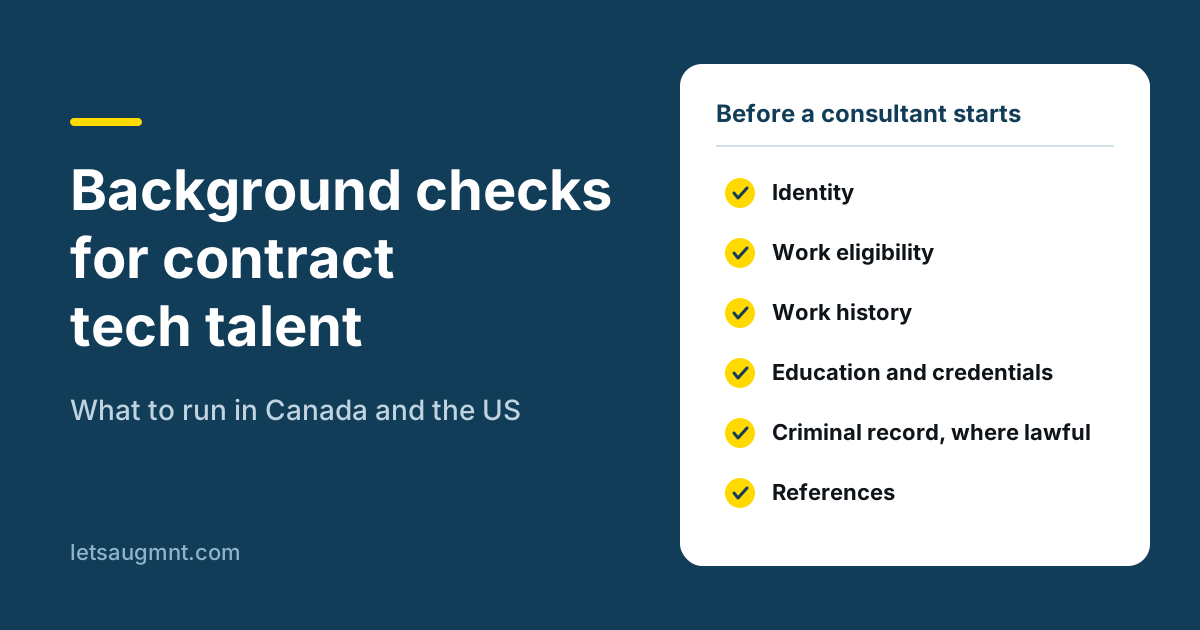
Background checks for contract tech talent usually cover identity, work eligibility, work history, credentials and, where the law allows, criminal records. Before any of it starts, get the consultant's written consent.
The rules differ by country, province and state. In Canada, human rights and privacy rules also vary by province. In the US, the Fair Credit Reporting Act sets steps for notice, consent and adverse action when an outside company runs the check. In Ontario, police record checks need written consent twice: once to run the check and once to share the results.
This guide covers what to check, what to settle before you start, and how to avoid a slow start date. It is general information, not legal advice. Confirm your approach with counsel, especially for contractors.
Key takeaways
- Get written consent first, in the form your jurisdiction requires.
- Match the checks to the role, and apply them the same way to every consultant.
- In Canada, human rights and privacy rules vary by province. In Ontario, police record check results need a second consent before they reach you.
- In the US, using an outside screening company triggers FCRA notice, consent and adverse action steps.
- There is no single turnaround time. Start the slow checks on day one.
- Settle in the contract who runs each check and what you will receive.
What do background checks for contract tech talent include?
Match the checks to the role and to what you may lawfully ask. Most contract tech engagements draw from the same short list.
| Check | What it confirms | Notes |
|---|---|---|
| Identity | The person matches the ID and the online profile | Live video call and ID match. Do this first, because every other check depends on it. |
| Work eligibility | The person can legally work where the work is done | A separate check from a background check. Do both. |
| Work history | Employers, titles and dates are real | Confirm with the employer or a verified record, not only the candidate's word. |
| Education and credentials | Degrees and certifications are real | Confirm with the school or issuer. If it cannot be confirmed, treat it as unconfirmed. |
| Criminal record | Convictions, within legal limits | Only where the law allows and the role justifies it. Needs written consent. |
| References | How the person worked | Speak to a former manager or client, ideally from a recent engagement. |
Credit and financial checks are rarely relevant to contract tech roles. Run them only if the role needs them and the law allows.
For the full four-check process, see our guide to verifying an AI or data consultant before you hire.
Canada: criminal record checks, human rights and privacy
Ontario: police record checks
In Ontario, the Police Record Checks Reform Act, 2015 sets the rules for police record checks. It came into force on November 1, 2018, according to Baker McKenzie's employment law blog. The Act defines three types of check, and each releases more than the one before.
| Type of check | What it adds |
|---|---|
| Criminal record check | Convictions without a pardon, within set limits |
| Criminal record and judicial matters check | Discharges within time limits, outstanding charges and warrants, and certain court orders |
| Vulnerable sector check | The most disclosure, including limited non-conviction information in narrow cases |
The vulnerable sector check exists for roles involving children or vulnerable people. It is unlikely to fit a typical tech contract.
Consent comes in two steps. The individual consents in writing to the specific type of check. After the check, the individual receives the results and then consents to share them with the requester. So a vendor cannot simply hand you a record check without that second consent. The same source notes that the information may only be used for the purpose it was requested.
Ontario human rights rules also apply. Section 5 of the Ontario Human Rights Code protects equal treatment in employment on the ground of "record of offences." Section 10 defines that term as a conviction for a pardoned offence or an offence under a provincial enactment. In practice, those records should not count against someone, subject to the exceptions the law allows.
Human rights rules across Canada
Protection for people with a criminal record depends on the province, or on federal law for federally regulated employers. Sources differ on some details, and the law changes. Confirm the rule for the place where the work is done.
| Where | The rule in short |
|---|---|
| Federal (federally regulated employers, such as banks) | The Canadian Human Rights Act protects applicants who have received a record suspension (a pardon). |
| Ontario | Protects "record of offences": pardoned federal offences and provincial offences. |
| British Columbia | Protects against refusal to hire for a conviction unrelated to the job. A tribunal has extended this to criminal charges. |
| Quebec | Protects against refusal to hire for a conviction in no way connected to the job, or one that was pardoned. |
| Newfoundland and Labrador, Prince Edward Island | Protects convictions unrelated to the job. |
| Yukon, Northwest Territories, Nunavut | Yukon covers criminal charges or record, with an exception for records relevant to the job. The Northwest Territories and Nunavut protect pardoned convictions. |
| Alberta, Saskatchewan, Manitoba, New Brunswick, Nova Scotia | Human rights laws do not mention criminal records. Manitoba's commission still accepts complaints on this ground. |
This table summarizes Canadian HR Reporter and First Reference, plus the Ontario Human Rights Commission page above. The First Reference piece is older, so treat the federal and territorial rows with extra care.
Where the law protects unrelated convictions, look at each case. Ask whether the offence connects to the job. A British Columbia court has pointed to the risk to the business, the circumstances of the offence, and the time since it happened.
Even where criminal records are not protected, another ground can still apply, such as race or disability. A record can also be wrong or belong to someone else, so talk to the person before you decide.
Privacy law and consent across Canada
Which privacy law applies depends on the province and the employer. Alberta, British Columbia and Quebec have their own private-sector privacy laws, which generally apply instead of the federal law (PIPEDA) inside those provinces. PIPEDA still applies to federally regulated businesses, such as banks, telecoms and transportation companies, and to the territories. The Office of the Privacy Commissioner says this must be worked out case by case.
Whichever law applies, collect only what is reasonably necessary. A Vancouver employment lawyer writing in Canadian HR Reporter says a blanket rule that every applicant for every role must have a criminal record check is unlikely to pass that test. A check is easier to justify for roles of trust. For tech contracts, that may point to checks tied to access to sensitive data or systems.
Across Canada, the applicant usually obtains the record check and passes it on to the employer. The same lawyer suggests waiting until you are ready to offer the role before you ask for one. Treat that as sensible practice and confirm it with counsel.
US: notice, consent and adverse action under the FCRA
It is not illegal to ask about a candidate's background or to require a check. That is the starting point of the joint FTC and EEOC guidance for employers. The same guidance sets out what to do when an outside company compiles the report.
- Give written notice. Tell the person you may use the report for decisions. It must be in writing and stand alone. It cannot sit inside an application form.
- Get written permission. This can be part of the same document as the notice.
- Certify to the screening company. Confirm that you gave notice, got permission, followed the FCRA, and will not misuse the information to discriminate.
- Before any adverse action, give the person a copy of the report and "A Summary of Your Rights Under the Fair Credit Reporting Act." This gives them a chance to review it and explain.
- After an adverse action, tell the person. Include the screening company's name, address and phone number, a statement that the company did not make the decision, and the person's right to dispute the report and get an extra free copy within 60 days.
Treat everyone the same way. The guidance warns that asking only some people about criminal or financial history is evidence of discrimination. It also says a policy that screens out people with certain records can be unlawful if it disproportionately affects a protected group and is not job related and consistent with business necessity.
Check state and city rules too. The guidance notes that some states and municipalities regulate background reports in hiring. It also asks employers to keep hiring records for one year and to dispose of background reports securely.
The guidance dates from 2014 and does not have the force of law, so check for updates before you build a process around it.
Contractors are not employees: who runs the check?
How these rules apply depends on how the engagement is set up. An independent contractor, a vendor's employee and a consultant placed through a staffing partner can each be treated differently. Both sources above are written for employers, so confirm with legal counsel how they apply to your contract.
Settle these points in writing before the check starts:
- Who runs which checks. You, the vendor, or both.
- Who holds the consent. And in what form your jurisdiction requires.
- What you receive. A full report, or a short pass or fail summary.
- Which jurisdiction's rules apply. Usually where the work is done, and sometimes where the consultant lives.
- How results are stored and deleted. And who can see them.
If a vendor says its consultants are "fully screened," ask what that covers. Ask which checks, in which countries, and what evidence you can see. A clear answer is a good sign. If you work with a partner in Ontario, ask how they obtain the second consent that lets police record check results reach you.
How long does a background check take?
There is no single number. Timing depends on which checks you run and where the records sit. Some checks depend on third parties who answer on their own schedule. Baker McKenzie advises Ontario employers to expect delays when they request police record checks.
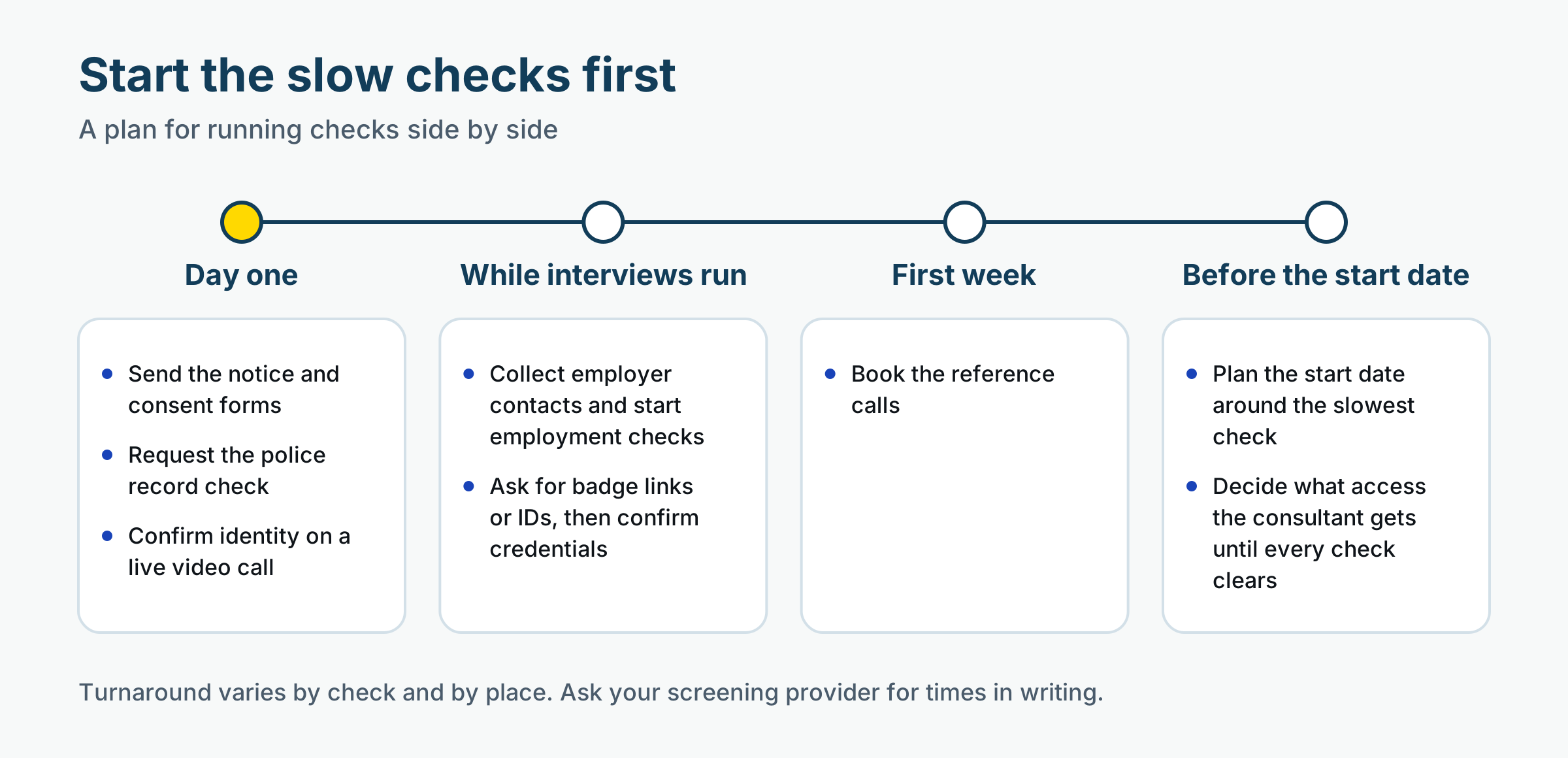
The way to shorten the wait is to start the slow parts first and run the rest side by side.
| Check | What slows it down | What to do |
|---|---|---|
| Police record check | The police service, plus two consent steps in Ontario | Send the consent request on day one. |
| Employment confirmation | How fast former employers reply | Collect contact details early and start while interviews run. |
| Education and credentials | How fast schools and issuers reply | Ask for badge links or IDs up front. |
| References | The referee's availability | Book the calls in the first week. |
| Checks in more than one country | Extra steps and different local rules | Ask your provider before you commit to a start date. |
Two more habits help. Ask your screening provider for turnaround times for each check and each jurisdiction, in writing. Then plan the start date around the slowest one.
Also decide in advance whether a consultant may start before every check clears, and what access they get until then.
Pre-start checklist and red flags
Use this list before a consultant starts.
- Identity confirmed on a live video call and against a government ID
- Work eligibility confirmed for the country where the work is done
- Written notice and written consent collected, in the form your jurisdiction requires
- Checks matched to the role and applied the same way to every consultant
- Employers, titles and dates confirmed
- Credentials confirmed with the issuer
- Two references spoken to, at least one recent client or manager
- A written record of who ran each check and what you received
- A decision on access until the checks clear
One red flag is a reason to ask more questions. Several together are a reason to pause.
- The consultant will not give consent for a check the role reasonably calls for
- Names, dates or employers differ between the resume, the profile and the ID
- The consultant will not name employers or allow reference calls
- A credential cannot be confirmed with the issuer
- A vendor cannot explain what "fully screened" covers
Frequently asked questions
Do you need consent for a contractor background check?
Yes. Get written consent first. In Ontario, police record checks need written consent to run the check and again to share the results. In the US, the FCRA requires written notice and written permission when you use an outside screening company. Confirm how this applies to your engagement.
What does a criminal record check show in Ontario?
It depends on the type. A criminal record check shows convictions without a pardon, within set limits. A criminal record and judicial matters check adds items such as outstanding charges and warrants. A vulnerable sector check discloses the most.
Can you reject a consultant because of a criminal record?
It depends on the jurisdiction, the role and how you apply the rule. In the US, a policy that disproportionately screens out a protected group must be job related and consistent with business necessity. In Canada, it varies by province. In Ontario, pardoned and provincial offences are protected in employment. In British Columbia and Quebec, a conviction unrelated to the job is protected. In Alberta, human rights law does not mention criminal records. Get legal advice before you reject anyone on this basis.
What is the difference between a background check and a work eligibility check?
A work eligibility check confirms the person can legally work where the work is done. A background check looks at history, such as employers, education and, where lawful, criminal records. Run both.
Can a staffing partner run these checks for you?
Many can. Ask what they check, in which jurisdictions, and what you will receive. Also ask who holds the consent.
If you would rather not run every check yourself
Running these checks on every consultant takes time. Some teams do it in house. Others use a partner.
At Augmnt, every consultant is checked for resume fraud, skills, work eligibility and background. Businesses can use the Augmnt platform to find consultants whose candidate profiles have been through those checks. They can also work with our staff augmentation team, who source, verify and deliver onshore consultants in the US and Canada.
You still decide who to hire, and the questions in this guide apply to any provider, including us. Ask what is checked, how, and what you will receive.
How Augmnt checks consultants
We run these checks ourselves. Before a consultant's candidate profile reaches a client, the process includes:
- AI resume scanning. Each resume goes through an AI scan.
- Human verification by phone. A person on our team calls the consultant and verifies the details directly, so the check does not rest on software alone.
- Work experience and claims. We check all work experience and the claims on the resume, not just a sample.
- Availability. We confirm the consultant's stated availability, so you are not planning around a start date that is not real.
This process verifies what a consultant claims. It is separate from a police record check, which has its own consent rules, covered above. If your engagement needs one, plan for it using the steps in this guide.
Related guides: resume fraud detection, candidate identity verification and technical candidate verification.
Hiring for a hard-to-fill AI, data or tech role? Tell us what you need and we will share verified candidate profiles.
Sources
Checked November 14, 2026.
- EEOC and FTC: Background Checks: What Employers Need to Know (issued March 11, 2014)
- Ontario Human Rights Commission: Relevant Ontario Human Rights Code provisions
- Baker McKenzie: Conducting a Police Record Check? What You Need to Know for November 1 (October 22, 2018)
- Canadian HR Reporter: Criminal charges and convictions (April 1, 2018)
- First Reference: criminal record checks and human rights (undated, older)
- Office of the Privacy Commissioner of Canada: Provincial laws that may apply instead of PIPEDA (modified May 11, 2020)