
IT Team Augmentation: A Complete Guide for 2026
Organizations across every sector face a persistent challenge in 2026: the need for specialized technical talent often outpaces their ability to hire and retain full-time employees. IT team augmentation has emerged as a strategic solution, enabling companies to access skilled professionals precisely when needed without the overhead and commitment of permanent hiring. This flexible approach to workforce management has transformed how businesses tackle ambitious projects, adopt emerging technologies, and maintain competitive advantage in rapidly evolving markets.
Understanding IT Team Augmentation
IT team augmentation represents a staffing strategy where businesses supplement their existing in-house teams with external technical professionals on a temporary or project-specific basis. Unlike traditional outsourcing, where entire projects are handed off to third-party vendors, augmentation integrates external talent directly into your existing workflows and culture.
This model provides businesses with immediate access to specialized skills while maintaining full control over project direction, daily operations, and strategic decisions. The augmented team members work alongside permanent staff, follow the same processes, and report through your established management structure.
Key Characteristics of the Augmentation Model
The distinguishing features of IT team augmentation include several operational elements that set it apart from other hiring strategies:
- Direct management control over augmented team members
- Seamless integration with existing teams and workflows
- Flexible engagement durations ranging from weeks to years
- Scalability to quickly adjust team size based on project demands
- Access to specialized expertise not available in-house
The flexibility inherent in this approach makes it particularly valuable for organizations navigating uncertain markets or pursuing innovation initiatives where skill requirements may shift rapidly.
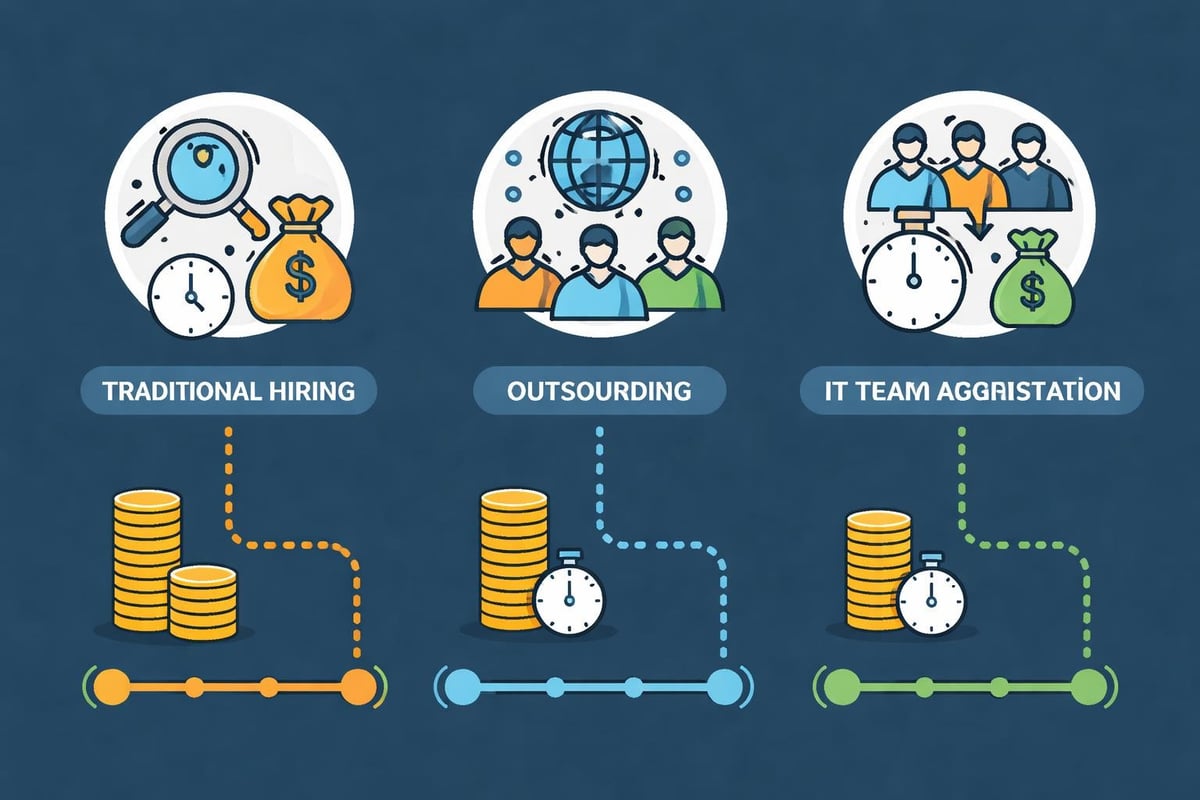
Strategic Benefits for Modern Businesses
Organizations implementing it team augmentation gain multiple competitive advantages that extend beyond simple headcount flexibility. The strategic value becomes apparent across several dimensions of business operations.
Cost Efficiency and Budget Predictability
Traditional hiring involves substantial upfront and ongoing costs including recruitment fees, benefits packages, office space, equipment, and training investments. Augmentation services eliminate many of these expenses while providing transparent, predictable pricing based on actual utilization.
| Cost Category | Traditional Hiring | IT Team Augmentation |
|---|---|---|
| Recruitment | $15,000-$30,000 per hire | Minimal to none |
| Benefits & Insurance | 25-40% of salary | Not required |
| Onboarding & Training | 3-6 months productivity loss | 1-2 weeks integration |
| Equipment & Space | $5,000-$15,000 per employee | Not required |
| Termination Risk | Severance, legal exposure | Flexible contracts |
Accelerated Time-to-Market
Speed represents a critical competitive factor in technology-driven markets. Building internal capabilities through traditional hiring typically requires three to six months from job posting to productive contribution. IT team augmentation compresses this timeline dramatically, often delivering qualified professionals within days or weeks.
Access to Specialized Expertise
The rapid evolution of technology creates constant demand for niche skills that may only be needed temporarily. Whether implementing machine learning algorithms, migrating legacy systems to cloud infrastructure, or developing blockchain applications, augmentation allows businesses to access expertise precisely when needed without long-term commitments.
This approach proves particularly valuable for AI and emerging technology projects where the talent pool remains limited and competitive. Organizations can engage specialists for critical development phases, then transition to maintenance with existing staff once systems are established.
Implementation Best Practices
Successfully deploying it team augmentation requires thoughtful planning and execution across several key areas. Organizations that approach augmentation strategically realize significantly better outcomes than those treating it as a simple hiring shortcut.
Define Clear Objectives and Requirements
Before engaging augmented professionals, establish concrete project goals, required technical skills, and success metrics. Vague requirements lead to mismatched talent and project delays.
Essential planning elements include:
- Detailed technical skill requirements and proficiency levels
- Project timeline with key milestones and deliverables
- Integration points with existing systems and teams
- Communication protocols and reporting structures
- Performance evaluation criteria
The specificity of these requirements directly correlates with placement success and early productivity.
Select the Right Augmentation Partner
The quality and reliability of your augmentation provider fundamentally determines program outcomes. Best practices for vendor selection emphasize rigorous evaluation across multiple dimensions beyond simple cost comparison.
Critical evaluation criteria:
- Candidate vetting processes including technical assessments and background verification
- Industry specialization and track record in your technology stack
- Cultural compatibility and communication capabilities
- Contractual flexibility and transparent pricing models
- Support infrastructure for issue resolution and candidate replacement
For organizations seeking AI talent specifically, platforms offering comprehensive validation become particularly valuable. Solutions like Augmnt ATS provide verified matching and candidate fraud detection, ensuring that presented professionals possess authentic credentials and demonstrated capabilities rather than embellished resumes.
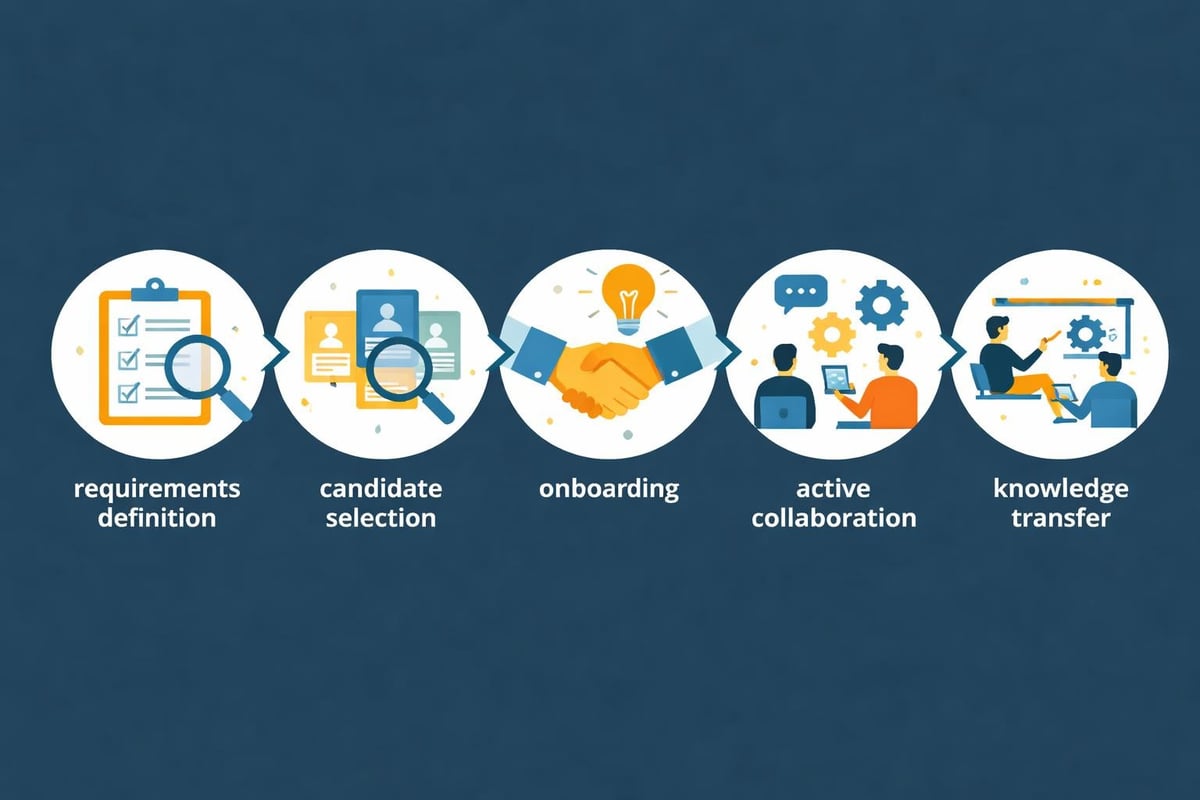
Prioritize Integration and Cultural Fit
Technical skills alone do not guarantee successful augmentation. Common challenges in staff augmentation frequently center on integration difficulties and cultural misalignment rather than technical inadequacies.
Integration best practices include:
- Assigning dedicated onboarding partners from your permanent team
- Providing complete access to necessary tools, documentation, and systems
- Including augmented members in team meetings, retrospectives, and social activities
- Establishing clear communication channels and response time expectations
- Creating psychological safety for questions and clarifications
The investment in thoughtful integration pays dividends through faster productivity ramp-up and higher quality collaboration throughout the engagement.
Common Challenges and Solutions
Despite its advantages, it team augmentation presents challenges that organizations must navigate effectively. Understanding these potential obstacles and their solutions enables proactive risk mitigation.
Communication and Collaboration Barriers
Distributed teams working across time zones and communication platforms face inherent coordination challenges. Research on staff augmentation challenges identifies communication gaps as a primary source of project friction and delays.
Mitigation strategies:
- Establish overlapping core hours for synchronous collaboration
- Implement comprehensive documentation practices using shared platforms
- Utilize video conferencing for complex discussions rather than relying solely on text
- Create explicit communication protocols defining response time expectations
- Schedule regular check-ins and status updates at predictable intervals
Knowledge Retention and Transfer
When augmented professionals complete their engagements, they take accumulated project knowledge with them. Without deliberate knowledge transfer processes, organizations may find themselves repeatedly paying for the same learning curves.
| Challenge | Impact | Solution |
|---|---|---|
| Undocumented decisions | Future maintenance difficulties | Require architectural decision records |
| Isolated expertise | Single points of failure | Implement pair programming and shadowing |
| Lost context | Rework and duplicated effort | Maintain comprehensive project wikis |
| Code opacity | Technical debt accumulation | Enforce code review and commenting standards |
Building knowledge retention into engagement structures from the beginning prevents these issues rather than attempting to address them retroactively.
Quality Control and Performance Management
Managing augmented team members requires the same rigor as permanent employees while acknowledging the temporary nature of the relationship. Effective team augmentation depends on clear performance expectations and regular feedback mechanisms.
Establishing measurable deliverables, conducting regular code reviews, and maintaining quality standards through automated testing helps ensure consistent output regardless of team composition. Treating augmented professionals as integral team members rather than external contractors improves accountability and engagement.
Selecting Optimal Use Cases
IT team augmentation delivers maximum value in specific organizational scenarios. Recognizing when augmentation represents the optimal staffing approach versus alternatives like traditional hiring or complete outsourcing improves strategic decision-making.
Ideal Augmentation Scenarios
Project-Based Development Initiatives
Fixed-duration projects with defined scopes and timelines represent ideal augmentation opportunities. Whether building a new product feature, migrating infrastructure, or implementing enterprise software, temporary skill infusion allows rapid execution without permanent headcount expansion.
Seasonal or Cyclical Demand
Organizations experiencing predictable workload fluctuations can scale capacity efficiently through augmentation rather than maintaining excess permanent staff during slower periods or missing opportunities during peak demand.
Skill Gap Bridging
When emerging technologies or specialized capabilities become strategically important but represent narrow requirements, augmentation provides immediate access while longer-term capability decisions crystallize. This approach proves particularly relevant for AI, blockchain, or other rapidly evolving domains.
Urgent Timeline Acceleration
Competitive pressures or market opportunities sometimes demand faster delivery than internal capacity allows. Augmentation enables rapid team scaling to meet aggressive deadlines that would otherwise require scope reduction or timeline extension.
When to Consider Alternatives
Certain situations call for different approaches. Building core competencies that represent lasting competitive advantages typically warrants permanent hiring and team development. Complete projects outside organizational expertise may benefit from full outsourcing rather than augmentation. Understanding these boundaries prevents misapplication of the augmentation model.
Decision tree for choosing between traditional hiring, IT team augmentation, outsourcing, and freelancers based on project duration, skill criticality, and control requirements
Managing Augmented Teams Effectively
The operational management of augmented teams requires adapting traditional management practices while maintaining core principles of effective leadership. Success depends on creating inclusive environments where augmented and permanent team members collaborate seamlessly.
Establishing Clear Governance
Define decision-making authority, escalation paths, and approval processes before augmented team members begin work. Ambiguity in governance creates delays and frustration as team members navigate unclear organizational dynamics.
Governance elements to clarify:
- Who owns technical architecture decisions
- How scope changes are requested and approved
- Which stakeholders require involvement in key decisions
- How conflicts between team members are resolved
- What circumstances trigger engagement modification or termination
Performance Monitoring and Feedback
Regular performance evaluation serves dual purposes: ensuring delivery quality and providing professional development opportunities for augmented team members. Best practices for scaling teams emphasize consistent feedback cycles rather than end-of-engagement assessments.
Weekly one-on-one meetings, sprint retrospectives, and objective key result tracking create accountability while building relationships that improve collaboration quality. Augmented professionals who receive constructive feedback and recognition demonstrate higher engagement and output quality.
Building Team Cohesion
Creating unified teams rather than "us versus them" dynamics requires intentional culture-building efforts. Including augmented members in team celebrations, professional development opportunities, and informal social interactions reduces friction and improves collaboration.
Simple practices like using inclusive language ("our team" rather than "contractors"), ensuring equal access to information and resources, and soliciting input from all team members regardless of employment status significantly impact team dynamics and performance.
Financial Considerations and ROI
Understanding the complete financial picture of it team augmentation enables accurate cost-benefit analysis and informed decision-making. While hourly or monthly rates for augmented professionals may appear higher than permanent employee salaries, comprehensive comparison reveals different economics.
Total Cost Comparison
| Expense Category | Annual Cost Per Employee | Annual Cost Per Augmented Member |
|---|---|---|
| Base Compensation | $120,000 | $156,000 (assuming $75/hour) |
| Benefits & Taxes | $42,000 (35%) | $0 |
| Recruitment | $25,000 (prorated) | $0 |
| Office & Equipment | $12,000 | $0 |
| Training & Development | $8,000 | $0 |
| Management Overhead | $15,000 | $8,000 |
| Total Annual Cost | $222,000 | $164,000 |
This analysis assumes full-year utilization. For shorter engagements or part-time needs, augmentation advantages increase substantially.
Calculating Return on Investment
ROI for it team augmentation extends beyond simple cost comparison to include velocity improvements, opportunity capture, and risk mitigation. Assessing the pros and cons requires evaluating multiple value dimensions rather than focusing exclusively on hourly rates.
Value considerations include:
- Accelerated time-to-market enabling earlier revenue generation
- Avoided opportunity costs from delayed or abandoned projects
- Reduced hiring risk through flexible commitments
- Access to expertise that would be unavailable through traditional hiring
- Preserved focus for permanent staff on core strategic initiatives
Organizations should establish clear success metrics before augmentation engagements to enable objective performance evaluation and continuous improvement of their augmentation strategies.
Future Trends in Team Augmentation
The it team augmentation landscape continues evolving in response to technological advancement, workforce preferences, and organizational needs. Understanding emerging trends helps organizations position their talent strategies for long-term success.
AI-Powered Talent Matching
Traditional augmentation relied heavily on manual screening and subjective assessments, creating inefficiencies and inconsistent quality. Advanced platforms now leverage artificial intelligence to match candidate capabilities with project requirements more accurately while detecting credential fraud and skill misrepresentation.
These technologies analyze technical assessments, work history patterns, and project outcomes to identify optimal fits beyond what resume reviews can reveal. The result is faster placement with higher success rates and reduced trial-and-error costs.
Hybrid Work and Global Talent Pools
Remote work normalization has eliminated geographic constraints that previously limited augmentation options. Organizations now access global talent pools, competing for expertise based on capability rather than proximity. This expansion increases available talent while introducing new management challenges around time zone coordination and cultural integration.
Specialized Augmentation Marketplaces
Generic staffing agencies are giving way to specialized platforms focused on specific technology domains. AI talent marketplaces, blockchain developer networks, and cybersecurity expert pools provide deeper expertise vetting and domain-specific matching that generalist providers cannot match.
These specialized platforms understand the nuanced skill requirements within their domains, enabling more accurate capability assessment and better project-candidate alignment. For organizations seeking cutting-edge capabilities, hiring managers benefit substantially from accessing these focused talent networks.
Building Long-Term Augmentation Strategies
Organizations realizing sustained value from it team augmentation treat it as a strategic capability rather than a tactical expedient. Developing repeatable processes, preferred provider relationships, and institutional knowledge around augmentation maximizes program effectiveness over time.
Creating Augmentation Playbooks
Document successful augmentation patterns within your organization including ideal engagement structures, effective onboarding processes, and proven integration techniques. These playbooks accelerate future implementations while reducing variance in outcomes across different projects and managers.
Developing Provider Partnerships
Rather than treating each augmentation need as an isolated transaction, cultivate relationships with providers demonstrating consistent quality and cultural alignment. Preferred partnerships enable faster mobilization, better rates through volume commitments, and deeper mutual understanding that improves matching accuracy.
Measuring and Optimizing Performance
Establish consistent metrics for evaluating augmentation effectiveness including time-to-productivity, delivery quality, cost-per-outcome, and stakeholder satisfaction. Regular analysis of these metrics reveals improvement opportunities and validates the business case for continued augmentation investment.
Organizations committed to continuous improvement in their augmentation programs outperform those approaching each engagement as a standalone experiment. Understanding common challenges and systematically addressing them through process refinement creates compounding advantages over time.
IT team augmentation has evolved from a stopgap hiring solution into a sophisticated strategic capability that enables organizations to compete effectively in talent-constrained markets. By providing flexible access to specialized expertise, reducing hiring risk, and accelerating project delivery, augmentation addresses critical business challenges that traditional staffing models cannot solve efficiently. Augmnt helps organizations maximize these benefits by connecting businesses with verified AI professionals through intelligent matching that eliminates credential fraud and ensures authentic capabilities, streamlining the path from talent need to productive contribution.