
How to Hire a Verified AI Consultant for Your Business
Why Verification Matters More Than Ever
In 2026, finding an IT consultant for hire who claims to have built a production retrieval pipeline is easy. Proving they actually built it is the hard part. That gap between claimed and demonstrated expertise now decides whether an AI engagement ships or stalls.
The pressure comes from both directions. AI skills have overtaken IT and engineering as the hardest skills for employers to hire, and 72% of employers worldwide report difficulty filling roles (ManpowerGroup, 2026). At the same time, Gartner predicts that by 2028, one in four candidate profiles worldwide could be fake (HR Dive, 2025).
Why companies bring in outside specialists has also changed. Only 34% of organizations now cite cost reduction as their main reason for outsourcing, down from 70% in 2020. Access to talent is the top driver, at 42% (Deloitte Global Outsourcing Survey 2024). Teams aren't trimming a budget line anymore. They're buying capability they can't build in-house fast enough through IT consulting services for businesses.
That raises the stakes of every hire. When you're paying for specialized skill rather than cheap hours, a mis-hire doesn't cost you a margin point. It costs you the project.
Build the Engagement Around Checkpoints
Whether a contract runs three months or twelve, AI and automation work tends to move through the same four phases: discovery and data readiness, build, evaluation and hardening, then handover. Scope the engagement around those phases, with a checkpoint at each one.
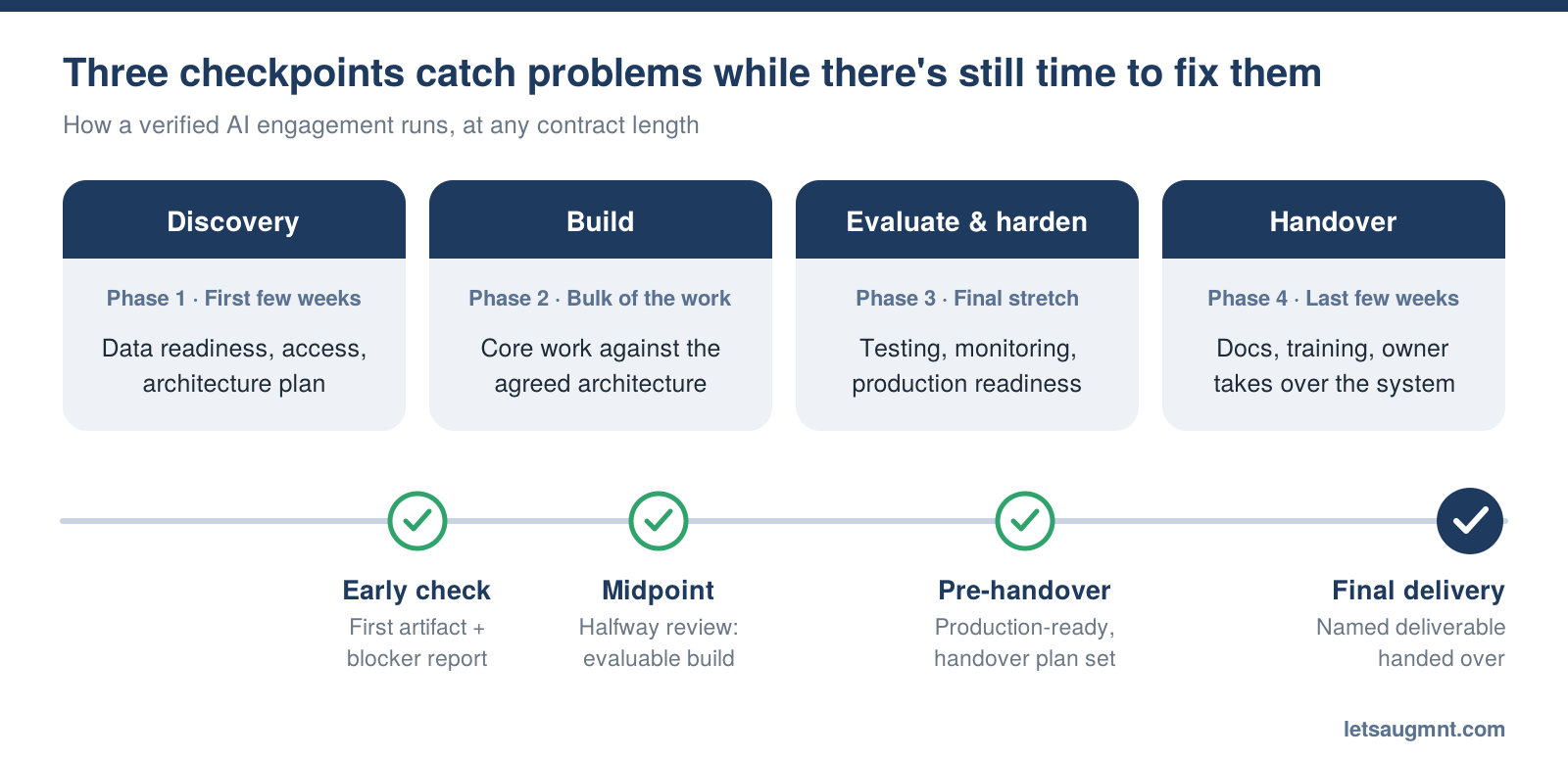
Each checkpoint gives you a concrete artifact to inspect. That way a capability gap shows up in the first few weeks, not after most of the budget is spent.
Scope Before You Source
Before you assess anyone, decide what you're actually buying. A contractor executes a specification you've already written. A consultant helps you write the specification, then executes it. Many stalled AI projects start with a team that needed a consultant but hired a contractor, or scoped the work so loosely that either could look like a fit.
Vague scope is also what makes an inflated resume work. A candidate can only misrepresent themselves against a requirement that was never clearly defined. In a January 2025 survey, 24% of U.S. job seekers admitted lying on a resume, most often about years of experience (38%) and skills (34%) (ResumeBuilder). Sharp requirements make those claims easy to test.
Before you go to market, write down:
The final deliverable: a deployed model, an automated process or a migrated data layer.
The proof: the artifact you'll inspect to confirm the work is real, such as a repo, an evaluation report or a live endpoint.
Hard technical requirements: frameworks, cloud platform, data volumes and regulatory constraints.
The internal owner: the person who inherits the system at handover.
Checkpoint KPIs: one early, one at the midpoint and one before handover.
IT Consultant Recruitment: Finding Verified AI Talent
Most sourcing channels are built for volume. Job boards, talent marketplaces and professional networks will surface hundreds of profiles claiming AI delivery experience, and almost none of those claims are checked. For a commodity role, volume means choice. For an AI build with a production dependency, it's a liability.
Traditional staffing agencies help with speed, not depth. Recruiters are usually measured on placements, and many lack the technical background to tell someone who fine-tuned a production model from someone who took a course on it. The resume passes a keyword screen, and the technical risk lands on your delivery team.
Verification-based sourcing flips this. It narrows the pool on purpose, checking identity, work eligibility and real technical skill before a profile ever reaches you. It's a more reliable approach to IT consultant recruitment: fewer candidates, all of them qualified.
Channel | Speed to shortlist | What gets verified | Where the risk sits |
|---|---|---|---|
Job boards and networks | Fast, high volume | Little or nothing | Your team screens everything |
Talent marketplaces | Fast | Platform reviews, some ID checks | Your team tests skills |
Traditional staffing agencies | Moderate | References, keyword match | Your delivery team, after kickoff |
Verification-based sourcing | Moderate, low volume | Identity, eligibility, technical skill | Checked before introduction |
How Bait-and-Switch and Resume Fraud Get Through
The classic bait-and-switch still works. A senior consultant runs the discovery call, answers your architecture questions and wins the engagement. After signing, delivery quietly moves to a junior resource, or to someone else entirely, while the senior name stays on the statement of work. You usually notice around week six, when answers start coming back vague.
The embellished resume is a quieter version: real projects, real employers, borrowed credit. The candidate was in the room when the model shipped but didn't build it. In AI work this is hard to catch in an interview, because the vocabulary of machine learning is easy to learn without the delivery experience behind it.
Outright identity fraud is no longer rare either. In a Gartner survey of 3,000 job candidates, 6% admitted to interview fraud, either posing as someone else or having someone pose as them (HR Dive). In June 2025, the U.S. Justice Department announced actions against North Korean remote IT worker schemes that used stolen or fake identities to get hired at more than 100 U.S. companies (U.S. Department of Justice).
Reference calls and whiteboard interviews catch some of this. They don't catch coordinated misrepresentation, identity substitution or a consultant who is quietly contracted elsewhere. That takes two layers working together:
Layer | What it catches | What it misses on its own |
|---|---|---|
Automated screening | Inconsistent timelines, duplicated or altered work history, unverifiable credentials, at scale | Whether the person can actually do the work |
Human-guided technical validation | Real depth on your stack; whether the person on the call is the person who will deliver | Patterns across hundreds of profiles |
Neither layer is enough alone.
Onboard for Delivery from Day One
On a fixed-length contract, every day spent waiting for a laptop, a repo invite or a data-access approval is a day taken from delivery, and you rarely get it back.
Before day one, finish and test:
Cloud console, repository and data-warehouse access
VPN, ticketing and any security training that gates production access
A context pack: architecture diagrams, data dictionaries, known constraints and the decision history behind the current system
Consultants bill for discovery either way, and written documentation is cheaper than verbal archaeology.
The first real signal of depth should arrive within the first month. By then, the consultant should have shipped something small but real to a non-production environment and written up what could block the main deliverable. That's early enough to act on if something is wrong.
Verified sourcing shortens the front end too. When identity, eligibility and skills are checked before introduction, the weeks usually lost to screening and re-screening go back into the delivery window.
Turning a Contract into a Hire
Not every engagement should end when the contract does. If the skill gap is permanent rather than project-specific, the contract doubles as an evidence-based evaluation that beats any interview loop.
A benchmark we find useful is 70/30. Expect a strong contract hire to cover about 70% of the permanent role on arrival. The other 30% is organizational context, domain knowledge and internal relationships that only come with time. Judging a consultant against 100% readiness on day one screens out people who would have become excellent employees.
Try-before-you-buy only works if it isn't a substitute for upfront verification. Finding out halfway through that someone can't do the work costs you half your delivery window.
Before converting, confirm that:
The contract allows conversion and spells out any fees or notice terms
Performance is documented against the agreed checkpoint KPIs, not impressions
Work eligibility and employment classification are verified for the relevant jurisdiction
IP assignment covers everything produced during the contract
The conversion conversation is booked well before the contract ends, before the consultant commits elsewhere
The Bottom Line
Verified skill beats an impressive resume. On a fixed timeline, a capability gap found halfway through leaves little room to recover.
Treat the contract as a delivery vehicle, not a trial. Scope it around a named deliverable and a handover plan, with dated checkpoint KPIs.
Bait-and-switch is a procurement problem. Name the delivering individual in the contract, and confirm at onboarding that the person building is the person you assessed.
Automate fraud detection, then apply human judgment. Software catches inconsistencies at scale; technical validation confirms depth on your stack.
Scope precisely before you source. Loose requirements make inflated claims defensible. Specific ones make them testable.
Front-load access and context. Provisioning delays spend delivery days you've already paid for.
How Augmnt Helps
Demand for specialized AI and data talent keeps growing, and so does the number of candidates positioning themselves into it. Most recruiting still relies on screening that was never built to catch coordinated misrepresentation.
Augmnt connects businesses with verified independent AI and data consultants. We combine automated fraud detection with human-guided technical validation to confirm identity, work eligibility and real skills before a consultant reaches your shortlist. For businesses buying IT consulting services, that means fewer candidates, each one already checked, and far less exposure to fake resumes and bait-and-switch.
What we verify before you see a profile:
Check | What it confirms |
|---|---|
Identity | The person on the call is who they say they are, and the person who will deliver |
Work eligibility | They can legally take on the engagement where you need them |
Work history | Employers, dates and projects line up, with no altered or borrowed claims |
Technical skills | Hands-on depth in the stack and tools you're actually building with |
Hiring for a hard-to-fill AI, data or tech role? Tell us what you need and get verified consultant profiles.
Sources
Global Talent Shortage Reaches Turning Point as AI Skills Claim Top Spot, ManpowerGroup, February 2026
Gartner: 1 in 4 job candidates could be fake by 2028, HR Dive, August 2025
Global Outsourcing Survey 2024, Deloitte, 2024
1 in 4 Americans Have Lied on Their Resume, ResumeBuilder, January 2025
Justice Department Announces Coordinated, Nationwide Actions to Combat North Korean Remote IT Worker Schemes, U.S. Department of Justice, June 2025
Key Takeaways
The final deliverable: a deployed model, an automated process or a migrated data layer.
The proof: the artifact you'll inspect to confirm the work is real, such as a repo, an evaluation report or a live endpoint.
Hard technical requirements: frameworks, cloud platform, data volumes and regulatory constraints.
The internal owner: the person who inherits the system at handover.
Checkpoint KPIs: one early, one at the midpoint and one before handover.