How to Hire ML Engineers: A 2026 Guide for Businesses
The demand for machine learning talent has reached unprecedented levels in 2026, with companies across industries racing to build AI capabilities. When you decide to hire ML engineers, you're not just filling a technical role-you're investing in the foundation of your organization's AI strategy. The challenge lies in navigating a competitive market where qualified candidates are scarce, compensation expectations are high, and distinguishing genuine expertise from inflated credentials has become increasingly complex. Understanding the current landscape and implementing robust hiring practices will determine whether your organization secures top talent or settles for mediocre outcomes.
Understanding the Machine Learning Engineer Landscape in 2026
The role of machine learning engineers has evolved dramatically over the past few years. These professionals now sit at the intersection of software engineering, data science, and systems architecture, requiring a unique blend of skills that extends far beyond basic model development.
What Defines a Machine Learning Engineer Today
Machine learning engineers are responsible for taking AI models from experimental notebooks to production-ready systems. They architect scalable infrastructure, implement MLOps pipelines, and ensure that models deliver consistent value in real-world applications.
Core responsibilities include:
- Designing and implementing end-to-end ML pipelines
- Optimizing model performance for production environments
- Integrating foundation models and large language models into business applications
- Maintaining data quality and model monitoring systems
- Collaborating with cross-functional teams to translate business requirements into technical solutions
The integration of foundation models has fundamentally changed what companies expect from ML engineers, shifting emphasis toward applied expertise rather than purely research-oriented skills.

Market Dynamics and Compensation Trends
The job market for machine learning engineers demonstrates robust growth, with salary ranges varying significantly based on experience and location. Entry-level positions typically command $90,000 to $130,000 annually, while senior engineers with five or more years of experience can earn $150,000 to $250,000 or more.
| Experience Level | Salary Range | Key Skills Required |
|---|---|---|
| Entry Level (0-2 years) | $90,000 - $130,000 | Python, TensorFlow/PyTorch, Basic ML algorithms |
| Mid Level (3-5 years) | $130,000 - $180,000 | Production deployment, MLOps, Cloud platforms |
| Senior Level (5+ years) | $180,000 - $250,000+ | System architecture, Team leadership, Business strategy |
Companies that hire ML engineers face intense competition, particularly for candidates with production experience. The AI talent market has seen a 74% year-over-year growth in job postings, creating a candidate-driven environment where top talent can be selective about opportunities.
Essential Skills to Evaluate When You Hire ML Engineers
Identifying the right skill set requires looking beyond surface-level qualifications. Machine learning engineering demands technical depth, practical experience, and the ability to navigate ambiguous problems.
Technical Proficiencies That Matter
Strong ML engineers demonstrate mastery across multiple technical domains. Programming proficiency in Python remains fundamental, but expertise in frameworks like TensorFlow, PyTorch, and increasingly, libraries for working with transformer models, has become essential.
Must-have technical skills:
- Programming and software engineering: Clean code practices, version control, testing frameworks
- Machine learning fundamentals: Supervised and unsupervised learning, deep learning architectures, model evaluation
- Data engineering: SQL, data pipelines, feature engineering, data validation
- Cloud and infrastructure: AWS/GCP/Azure, containerization with Docker, Kubernetes orchestration
- MLOps practices: Model versioning, experiment tracking, continuous integration/deployment for ML systems
The ability to work with cloud platforms has transitioned from optional to mandatory. Engineers need hands-on experience deploying models at scale, managing computational resources efficiently, and implementing monitoring solutions that catch drift and performance degradation.
Soft Skills and Problem-Solving Abilities
Technical skills alone don't guarantee success. When you hire ML engineers, evaluate their communication abilities, particularly how they explain complex technical concepts to non-technical stakeholders. Machine learning projects often fail not because of algorithmic limitations but due to misalignment between technical solutions and business needs.
Problem-solving approach reveals how candidates tackle ambiguity. Present real scenarios from your business context and observe whether they ask clarifying questions, consider trade-offs, and propose pragmatic solutions rather than defaulting to the latest trending techniques.
Common Pitfalls When Hiring Machine Learning Engineers
Organizations frequently make preventable mistakes during the hiring process that result in poor matches, extended time-to-hire, or candidates who fail to deliver value once onboard.
Overemphasizing Academic Credentials
While educational background provides valuable context, placing too much weight on advanced degrees can exclude talented engineers who developed skills through practical experience. The relationship between formal education and job performance isn't as straightforward as many assume.
Focus instead on demonstrated ability to solve real problems. A candidate who has deployed models handling millions of predictions daily often brings more immediate value than someone with impressive research publications but no production experience.
Neglecting Programming and Engineering Assessment
One of the most common mistakes when hiring AI and ML engineers involves failing to rigorously test programming skills. Machine learning requires strong software engineering fundamentals-not just the ability to run Jupyter notebooks.
Assessment areas to include:
- Code quality and structure
- Debugging and troubleshooting abilities
- System design for ML applications
- Understanding of computational complexity
- API design and integration skills
Implement practical coding assessments that mirror actual work challenges. Ask candidates to optimize a slow data pipeline, debug a model serving issue, or design an architecture for a specific use case.

Ignoring Resume Fraud and Credential Inflation
The competitive landscape has unfortunately led to increased credential exaggeration and outright resume fraud. Candidates may claim expertise with technologies they've barely used, inflate their role in previous projects, or misrepresent their education.
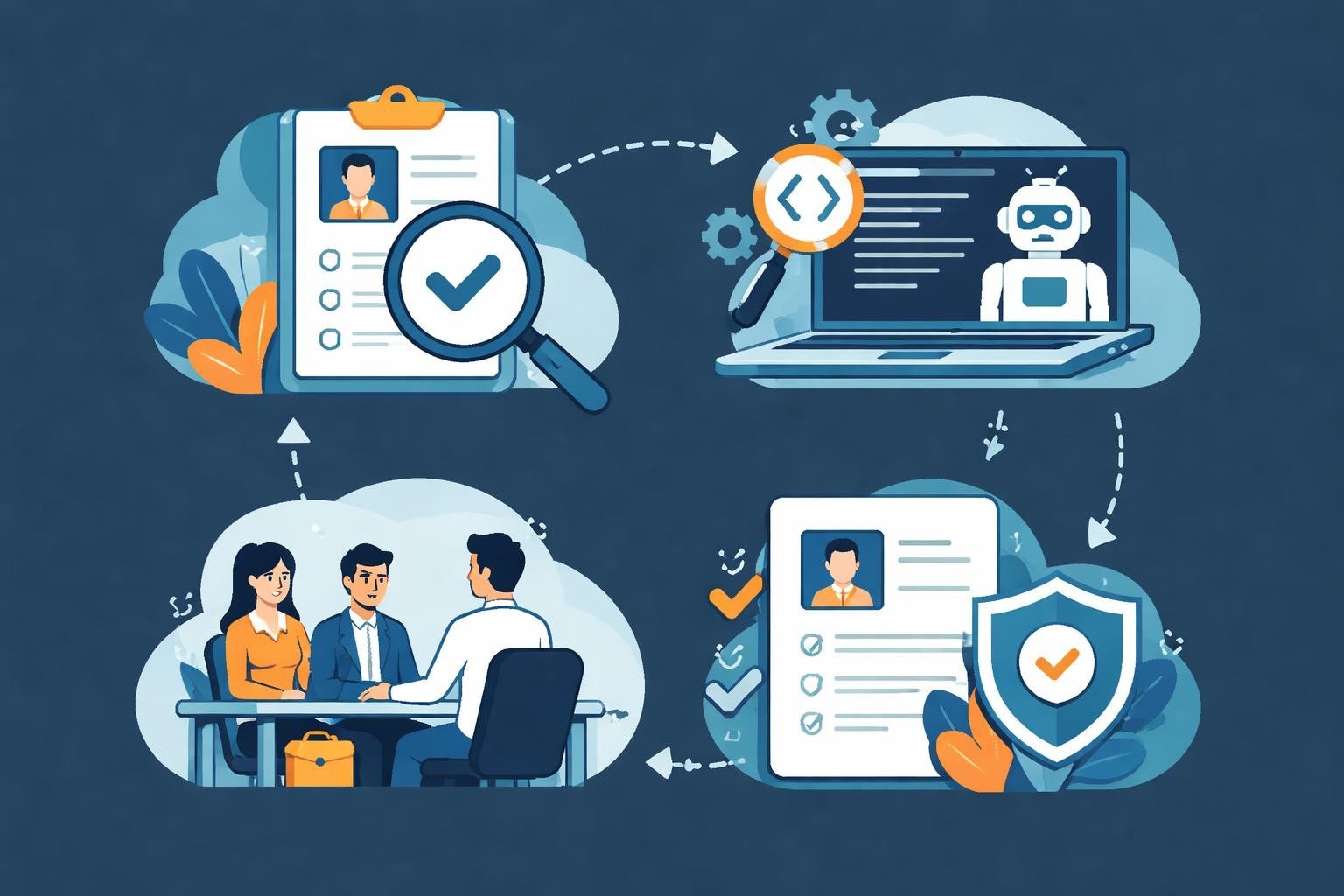
Verification becomes critical when you hire ML engineers. This includes validating educational credentials, verifying employment history, and conducting technical assessments that reveal actual skill levels rather than claimed expertise. Platforms like Augmnt ATS provide comprehensive candidate validation, including resume fraud detection and skill verification, to help employers identify qualified, fraud-free candidates efficiently.
Building an Effective Hiring Process
A structured, well-designed hiring process improves your ability to identify top talent while providing candidates with a positive experience that reflects well on your organization.
Crafting Compelling Job Descriptions
Job descriptions serve as the first filter in your hiring funnel. Be specific about what the role entails, the problems the engineer will solve, and the technologies they'll work with. Vague descriptions attract generic applications, while detailed postings attract candidates whose experience aligns with your needs.
Include information about your data infrastructure, the scale of your ML operations, and the business impact of the role. Engineers want to understand whether they'll be building from scratch, optimizing existing systems, or researching new approaches.
| Component | What to Include | What to Avoid |
|---|---|---|
| Role Summary | Specific business problems, team structure, impact metrics | Generic "cutting-edge AI" language |
| Requirements | 3-5 must-have skills, 2-3 nice-to-have skills | Exhaustive lists of every possible technology |
| Project Examples | Real scenarios they'll work on, technologies in use | Confidential details, unrealistic expectations |
| Compensation | Salary range, equity details, benefits overview | "Competitive salary" without specifics |
Structuring Technical Interviews
Design interviews that assess both depth and breadth of knowledge. Start with fundamental concepts before moving to advanced topics. A candidate who struggles with basic probability or can't explain gradient descent likely won't succeed in complex model development.
Recommended interview structure:
- Initial screening (30 minutes): Background review, motivations, basic technical questions
- Coding assessment (60-90 minutes): Practical programming challenge, data manipulation, algorithm implementation
- ML system design (60 minutes): Architecture discussion for a realistic business problem
- Behavioral interview (45 minutes): Past project deep-dives, collaboration examples, conflict resolution
- Final conversation (30 minutes): Team fit, questions about company, role expectations
Involve multiple team members in the process to gather diverse perspectives. Engineers who will work closely with the hire should participate in technical interviews, while stakeholders from product or business teams can assess communication and alignment.
Reference Checks and Portfolio Review
Don't skip reference checks. Former managers and colleagues provide invaluable insights into work style, collaboration abilities, and actual contributions to previous projects. Ask specific questions about the candidate's role in successful projects and how they handled challenges.
Review portfolios and GitHub profiles when available. Look for code quality, documentation practices, and whether projects demonstrate the skills claimed on the resume. Active contributors to open-source ML projects often bring valuable experience in collaborative development.
Sourcing Strategies for Machine Learning Talent
Finding qualified candidates requires going beyond traditional job boards. The best ML engineers often aren't actively job hunting, necessitating proactive sourcing approaches.
Leveraging Specialized Platforms
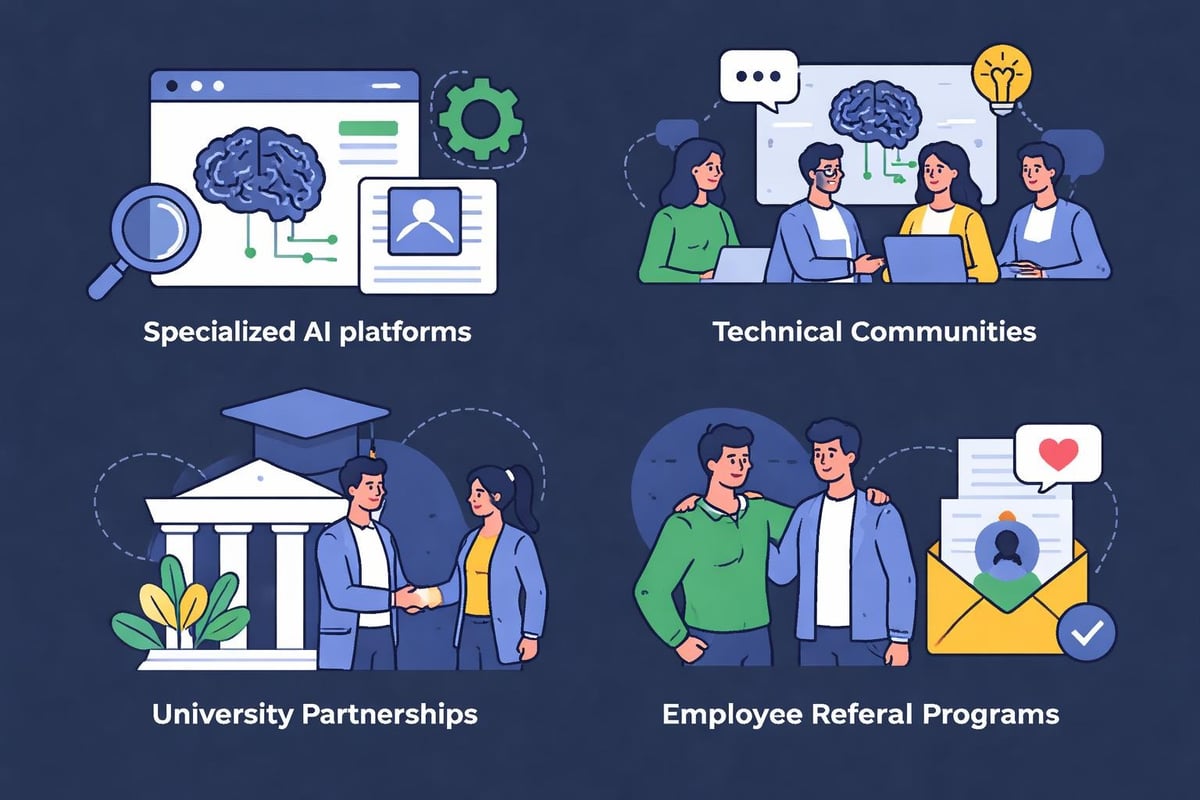
While general job boards attract volume, specialized platforms focused on AI and ML talent deliver higher-quality candidates. These platforms often include pre-vetted professionals who have demonstrated technical competency through assessments or portfolio reviews.
When you apply through specialized AI talent platforms, you gain access to engineers who are specifically interested in machine learning roles and have been validated for their skills. This dramatically reduces the time spent filtering unqualified applicants.
Building Talent Pipelines
Successful organizations don't wait until they have an immediate opening to hire ML engineers. They cultivate relationships with potential candidates through ongoing engagement, even when no positions are available.
Pipeline development tactics:
- Sponsor or host ML meetups and conferences
- Contribute to open-source projects relevant to your domain
- Publish technical blog posts about your ML infrastructure and challenges
- Offer internships or fellowship programs for emerging talent
- Maintain relationships with candidates who interviewed well but weren't hired
This approach ensures that when you need to hire ML engineers quickly, you have warm leads rather than starting from scratch.
Retention and Onboarding Considerations
Hiring is only the beginning. Retaining ML engineers requires providing the right environment, resources, and growth opportunities.
Creating the Right Work Environment
Machine learning engineers thrive when they have access to quality data, appropriate computational resources, and the autonomy to experiment with different approaches. Organizations that treat ML as an afterthought or fail to invest in proper infrastructure will struggle with retention.
Provide clear paths for impact. Engineers want to see their models actually used in production, affecting business outcomes. Nothing demoralizes ML talent faster than building models that never ship or working on projects that get repeatedly deprioritized.
Continuous Learning and Development
The field evolves rapidly, with new techniques, frameworks, and best practices emerging constantly. Support continued education through conference attendance, online courses, and dedicated time for exploration and skill development.
Retention strategies that work:
- Allocate 10-20% time for learning and experimentation
- Create internal knowledge-sharing sessions where engineers present new techniques
- Support conference attendance and speaking opportunities
- Provide clear career progression paths beyond people management
- Recognize and reward successful model deployments and improvements
Engineers who feel they're growing professionally and making meaningful contributions are far less likely to pursue external opportunities, even when recruiters approach with higher compensation offers.
Balancing Speed and Quality in Hiring
Organizations face pressure to fill ML engineering roles quickly, but rushing the process often leads to poor hires that create more problems than they solve.
Setting Realistic Timeline Expectations
Quality candidates typically have multiple opportunities and won't remain available indefinitely. However, compressed timelines that skip crucial evaluation steps increase the risk of hiring someone who lacks necessary skills or doesn't align with your culture.
Aim for a process that takes 2-4 weeks from initial contact to offer. This provides sufficient time for thorough evaluation without losing candidates to competing offers. Communicate clearly with candidates about timeline expectations and stick to commitments.
When to Compromise and When to Hold Firm
Not every hire needs to check every box on your wish list. When you hire ML engineers, distinguish between essential requirements and nice-to-have skills that can be developed on the job. A candidate strong in fundamentals can learn new frameworks relatively quickly.
However, never compromise on integrity, communication abilities, or core programming skills. These foundational elements rarely improve significantly and create ongoing challenges if lacking.
Adapting to Remote and Global Talent
The shift toward remote work has expanded the potential talent pool dramatically, allowing organizations to hire ML engineers regardless of geographic location.
Building Effective Remote Hiring Processes
Remote interviewing requires adjustments to ensure accurate assessment. Video interviews can reveal communication skills but may miss subtle cues visible in person. Compensate with structured questions and clear evaluation rubrics.
Technical assessments work particularly well in remote contexts. Candidates complete coding challenges on their own time, providing insight into how they work without the pressure of someone watching over their shoulder.
Managing Distributed ML Teams
Once you hire ML engineers in different locations, establish practices that keep teams connected and productive. Regular video check-ins, collaborative documentation, and asynchronous communication tools become essential.
Consider time zone overlap when hiring. Teams spread across too many time zones struggle with real-time collaboration, which remains valuable for complex problem-solving discussions and architecture decisions.
Building a strong machine learning engineering team requires careful planning, robust evaluation processes, and ongoing commitment to creating an environment where talented engineers can thrive. When you hire ML engineers, you're making a strategic investment that demands thorough vetting and thoughtful integration. Augmnt simplifies this challenge by connecting businesses with verified AI professionals through intelligent matching and comprehensive candidate validation, ensuring you find qualified, fraud-free talent efficiently. Whether you're building your first ML team or scaling an existing one, partnering with a platform that prioritizes quality and verification can accelerate your hiring success.