
AI Consultants: Your 2026 Guide to Hiring and Working
The artificial intelligence revolution has transformed how businesses operate, but implementing AI solutions requires specialized expertise that most organizations lack in-house. AI consultants have emerged as critical partners for companies navigating digital transformation, offering the technical knowledge and strategic insight needed to leverage machine learning, natural language processing, and other AI technologies effectively. As we progress through 2026, the demand for qualified AI consultants continues to surge across industries, from healthcare and finance to manufacturing and retail.
What AI Consultants Actually Do
AI consultants serve as strategic advisors and technical experts who help organizations identify, implement, and optimize artificial intelligence solutions. Their role extends far beyond simple technology recommendations.
These professionals begin by conducting comprehensive assessments of a company's current technological infrastructure, business processes, and strategic objectives. They identify opportunities where AI can deliver measurable value, whether through automation, predictive analytics, customer experience enhancement, or operational efficiency gains.
Core Responsibilities and Deliverables
The scope of work for AI consultants typically includes several key areas:
- Strategic roadmap development for AI adoption aligned with business goals
- Use case identification and prioritization based on ROI potential
- Technology stack recommendations including platforms, tools, and frameworks
- Implementation planning with timelines, resource allocation, and risk mitigation
- Vendor evaluation and selection for AI platforms and services
- Change management support to ensure organizational readiness
Beyond strategy, many ai consultants also provide hands-on technical services. They may develop proof-of-concept models, build custom AI solutions, integrate third-party AI tools, or train internal teams on AI technologies. The specific mix of strategic versus technical work varies based on the consultant's background and the client's needs.

The Growing Market for AI Consulting Services
The AI consulting industry has experienced explosive growth over the past several years. According to the Artificial Intelligence Index Report 2024, enterprise AI adoption has accelerated significantly, with organizations increasingly turning to external experts to navigate this complex landscape.
Market dynamics reveal several compelling trends shaping the industry in 2026:
| Trend | Impact | Business Implication |
|---|---|---|
| Increased AI democratization | More accessible tools and platforms | Greater need for strategic guidance over basic implementation |
| Regulatory complexity | Growing compliance requirements | Demand for consultants with trustworthy AI frameworks expertise |
| Specialized industry AI | Sector-specific solutions | Rise of niche consultants in healthcare, finance, manufacturing |
| Generative AI adoption | Rapid organizational interest | Need for experienced consultants to separate hype from value |
The talent shortage remains a defining characteristic of the AI consulting market. Organizations struggle to find qualified professionals who combine technical AI expertise with business acumen and industry knowledge. This scarcity has driven up consulting rates while simultaneously creating opportunities for fraud and misrepresentation in the marketplace.
Industry-Specific Consulting Needs
Different sectors require distinct AI expertise. Healthcare organizations need consultants familiar with HIPAA compliance and medical data privacy. Financial services require professionals who understand regulatory frameworks like Basel III and can implement AI within strict risk management parameters. Manufacturing clients seek experts in computer vision, predictive maintenance, and supply chain optimization.
Specialized platforms like Maven Bio for BioPharma consultants demonstrate how AI consulting is becoming increasingly verticalized, with consultants developing deep domain expertise in specific industries rather than offering generic AI services.
Essential Skills and Qualifications
Not all AI consultants possess equal capabilities. The most effective professionals combine technical prowess with business strategy skills and exceptional communication abilities.
Technical Competencies
Strong ai consultants demonstrate proficiency across multiple technical domains:
- Machine learning fundamentals including supervised, unsupervised, and reinforcement learning
- Programming skills in Python, R, or other data science languages
- Deep learning frameworks such as TensorFlow, PyTorch, or JAX
- Data engineering capabilities including data pipelines, warehousing, and quality management
- Cloud platforms expertise with AWS, Azure, or Google Cloud AI services
- Model deployment and MLOps practices for production environments
However, technical skills alone do not make an effective consultant. The ability to translate complex AI concepts into business language, understand organizational dynamics, and navigate corporate politics proves equally valuable.
Business and Soft Skills
The best AI consultants excel at stakeholder management, having worked with executives, technical teams, and end users across various organizational levels. They demonstrate strong project management capabilities, keeping initiatives on track despite inevitable obstacles and shifting priorities.
Communication stands out as perhaps the most underrated skill. Consultants must explain technical concepts to non-technical audiences, document their recommendations clearly, and present findings persuasively to decision-makers who control budgets and resources.
How to Hire the Right AI Consultant
Finding qualified AI consultants requires a systematic approach that balances technical verification with cultural fit assessment. The high demand and lucrative rates have unfortunately attracted unqualified individuals who misrepresent their credentials.
Defining Your Requirements
Before beginning your search, clearly articulate what you need from an AI consultant:
- Are you seeking strategic guidance, technical implementation, or both?
- Do you need industry-specific expertise?
- What deliverables do you expect (strategy documents, working models, training programs)?
- What is your timeline and budget?
- Will the consultant work independently or lead internal teams?
Precise requirements help you evaluate candidates effectively and avoid mismatches that waste time and resources.

Verification and Validation
Resume fraud represents a significant challenge when hiring AI consultants. Candidates may exaggerate their experience with specific technologies, inflate their role in past projects, or fabricate credentials entirely.
Implement a rigorous verification process:
- Request work samples and case studies from previous engagements
- Conduct technical assessments tailored to your specific needs
- Verify claimed certifications and educational credentials
- Check references thoroughly, speaking directly with previous clients
- Review any published work, conference presentations, or open-source contributions
For organizations lacking internal AI expertise to evaluate candidates, platforms like Augmnt ATS provide verified matching and candidate fraud detection specifically designed for technical roles, helping ensure you connect with genuinely qualified professionals.
| Verification Method | Effectiveness | Time Investment |
|---|---|---|
| Resume review alone | Low | Minimal |
| Technical interviews | Medium-High | Moderate |
| Work sample evaluation | High | Moderate-High |
| Reference checks | Medium | Moderate |
| Third-party verification | High | Low |
Working Effectively with AI Consultants
Hiring the right consultant represents only the first step. Maximizing the value from the engagement requires deliberate effort from both parties.
Setting Clear Expectations
Begin every consulting engagement with explicit agreements on scope, deliverables, timelines, and success metrics. Document these in a formal statement of work that both parties reference throughout the project.
Establish communication protocols early. How frequently will you meet? What reporting format does the consultant use? Who serves as the primary point of contact? Clear answers prevent misunderstandings that derail projects.
Enabling Consultant Success
AI consultants require certain resources to perform effectively:
- Access to relevant data including historical records, current systems, and business metrics
- Stakeholder availability for interviews, requirements gathering, and feedback sessions
- Technical infrastructure such as development environments and computing resources
- Decision-making authority with clear escalation paths for approvals
- Internal champion support from executives who advocate for the initiative
Organizations that treat consultants as outsiders and withhold information inevitably receive subpar results. The most successful engagements involve consultants as temporary team members with appropriate access and support.
Managing the Relationship
Regular check-ins help keep projects on track. Schedule weekly or biweekly status meetings to review progress, address obstacles, and adjust plans as needed. These touchpoints provide opportunities to course-correct before small issues become major problems.
Encourage open dialogue about challenges and concerns. AI consultants bring valuable outside perspectives, but they need psychological safety to share difficult truths about technical feasibility, organizational readiness, or strategic misalignment.
AI Tools Consultants Use in 2026
Modern ai consultants leverage an extensive toolkit of platforms and solutions to deliver value efficiently. The top AI tools for consultants span multiple categories from client communication to technical development.
Productivity and Knowledge Management
Consultants increasingly use AI-powered tools to enhance their own productivity. Conversational AI assistants help with research, document creation, and client communication. Knowledge management platforms organize insights from multiple engagements, enabling consultants to draw on past experiences when advising new clients.
Enterprise-focused solutions like SAP Joule for Consultants provide AI assistance grounded in trusted organizational knowledge, accelerating project timelines and cloud transformations through expert guidance.
Technical Development Platforms
For consultants engaged in hands-on implementation work, modern AI development platforms streamline model building, training, and deployment:
- AutoML platforms that automate model selection and hyperparameter tuning
- Feature stores for managing and sharing ML features across teams
- Experiment tracking tools that document model iterations and performance
- Model serving infrastructure for deploying models to production
- Monitoring solutions that detect model drift and performance degradation
These tools allow consultants to deliver production-ready solutions faster while maintaining quality and reliability.
Requirements for Trustworthy AI Tools
As highlighted in the analysis of essential requirements consultants need from AI tools, professionals operating in high-stakes environments demand consistency, transparency, completeness, and authority from their technology solutions. Consultants stake their reputations on the advice they provide, making tool reliability non-negotiable.
The Future of AI Consulting
The AI consulting landscape continues evolving rapidly as technology advances and organizational maturity increases. Several trends will shape the profession through the remainder of this decade.
Specialization and Verticalization
Generalist AI consultants face increasing competition from specialists with deep expertise in specific industries or technologies. We expect continued growth in niche consulting practices focused on particular AI applications or vertical markets.
Professional consultants like Zöe Webster, who combine AI technical expertise with strategic business insight, demonstrate the evolving profile of successful practitioners in this field.
Integration with Broader Digital Transformation
AI consulting is becoming inseparable from overall digital transformation initiatives. Rather than standalone AI projects, organizations seek consultants who understand how AI integrates with cloud migration, data modernization, process automation, and cultural change.
This integration requires AI consultants to broaden their skill sets beyond pure machine learning, understanding enterprise architecture, change management, and business process reengineering.
Ethical and Regulatory Complexity
Growing regulatory scrutiny around AI systems demands consultants stay current with compliance requirements across jurisdictions. The European Union's AI Act, various state-level regulations in the United States, and industry-specific guidelines create a complex compliance landscape.
Consultants who help organizations navigate these requirements while maintaining AI system effectiveness will command premium rates as regulatory complexity increases.
Building Long-Term Consultant Relationships
While many organizations engage AI consultants for specific projects, the most strategic approach involves developing ongoing relationships with trusted advisors.
Retainer arrangements provide organizations with consistent access to expertise as questions and challenges arise. Rather than starting from scratch with each new initiative, retained consultants develop deep familiarity with your business, technology environment, and organizational culture.
Consider transitioning successful project-based consultants into advisory roles where they guide your AI strategy over time. This continuity proves especially valuable as AI technologies evolve and new opportunities emerge.
Knowledge Transfer and Capability Building
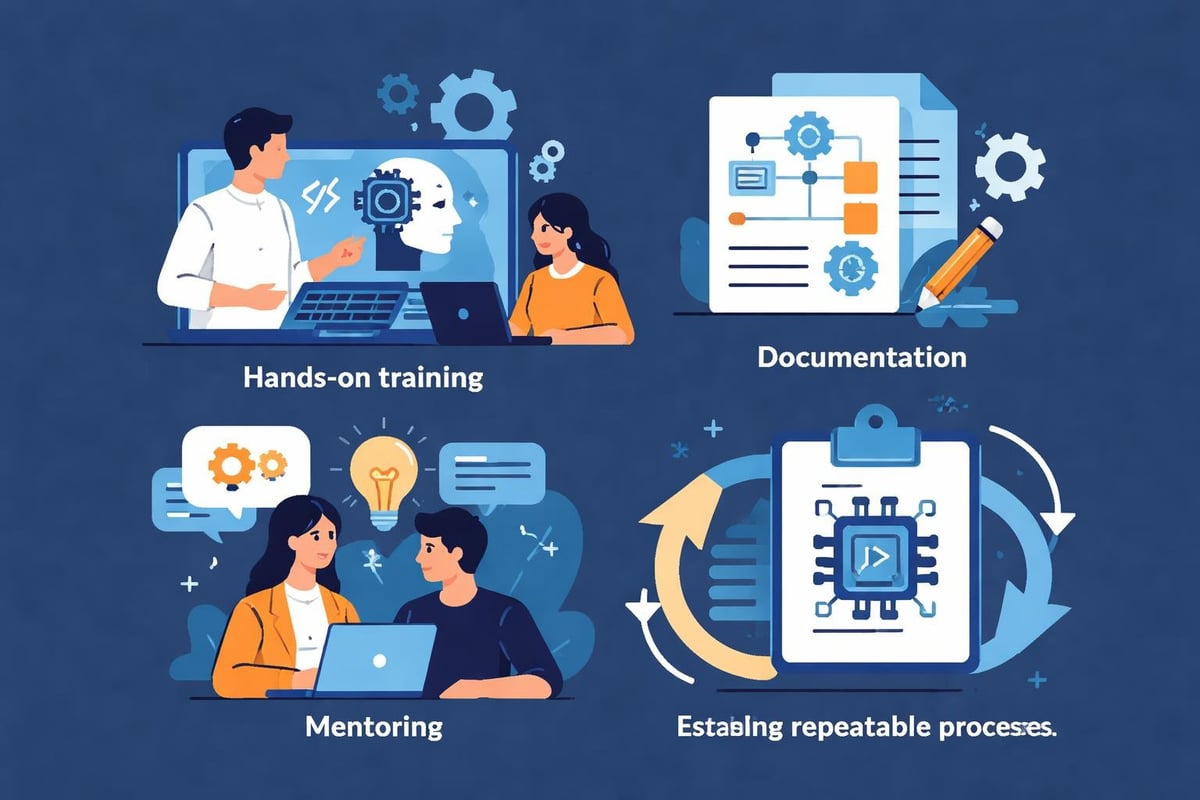
Effective AI consultants don't just deliver solutions; they build internal capabilities that reduce future dependence on external expertise. Seek consultants who prioritize knowledge transfer through:
- Documentation of technical architectures, models, and decision rationale
- Training programs that upskill internal teams on AI concepts and tools
- Mentoring relationships pairing consultants with internal staff
- Process establishment creating repeatable frameworks for future AI initiatives
The best consulting engagements leave organizations more capable than when they started, not dependent on continued external support for basic operations.
Measuring Consultant Impact and ROI
Quantifying the value delivered by AI consultants helps justify the investment and identify top performers for future engagements.
Establish clear success metrics before the engagement begins:
- Strategic deliverables completed on time and meeting quality standards
- Technical outcomes such as model accuracy, system performance, or automation rates
- Business results including cost savings, revenue growth, or efficiency gains
- Capability development measured by internal team skill improvements
- Timeline adherence evaluating project completion versus original estimates
For strategic consulting without immediate technical implementation, measuring impact proves more challenging but remains important. Track how consultant recommendations influence decision-making, whether proposed initiatives move forward, and if strategic direction changes based on their input.
Avoiding Common Pitfalls
Organizations frequently make predictable mistakes when working with ai consultants:
Unclear scope and objectives lead to misaligned expectations and disappointing results. Invest time upfront defining exactly what you need and how success will be measured.
Insufficient internal support dooms even the best consultants to failure. If your organization lacks commitment, data access, or resources, delay the engagement until these prerequisites exist.
Resistance to change undermines AI initiatives regardless of consultant quality. Address organizational readiness issues before bringing in external experts to avoid wasting resources on solutions that won't be adopted.
Over-reliance on consultants for operational decisions creates dependency rather than building capability. Use consultants to guide and advise, but maintain internal ownership of AI strategy and implementation.
Successfully leveraging AI consultants requires matching your specific organizational needs with genuinely qualified professionals who possess both technical expertise and business acumen. As the AI consulting market continues maturing in 2026, organizations must implement rigorous verification processes to separate truly skilled practitioners from those misrepresenting their capabilities. If you're ready to connect with verified AI professionals who have been thoroughly vetted for both technical competency and credential authenticity, Augmnt provides an intelligent marketplace that streamlines the hiring process through comprehensive candidate validation and fraud detection.